Thursday, January 27, 2011

E Book Reader


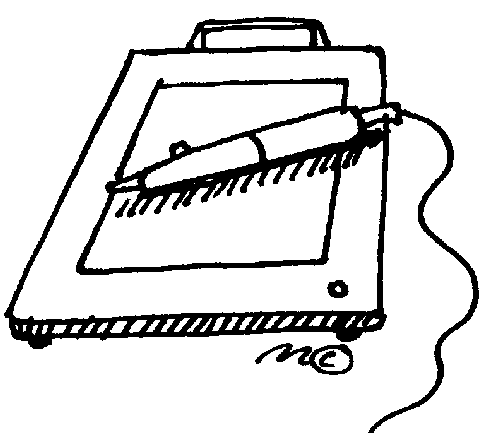
Technology has the potential to help dyslexics quite considerably .One such technological aid is an E book reader. The E book reader is a small portable computer device which enables you to download books which you can read wherever you are.

There are a number of readers available for example : Kindle Amazon , Nook( Barnes and Noble), Sony E Reader, Ipad, Reeder ( this brand is sold a lot in Turkey) etc.


Advantages

The font size can be enlarged.

Kindle ( Amazon) has a text to speech option allowing children to listen to the book while they follow the text, which in turn can help to improve comprehension.


The text to speech facility also would enable dyslexic children to tackle a more difficult book than they would normally read by themselves. In addition this option would be useful not only for recreational reading but for reading textbooks.

Children are generally drawn to technology and it might help to make reading seem more appealing to reluctant readers.

Possible Problems

The initial cost of the e book reader .

Some publishers have decided that it is a copyright infringement to have the book read out .As a result not all E books allow you to use the“text to speech” option.


Unfortunately the choice of e books in Turkish is considerably more limited compared to books written in English. The “Kindle Reader” does not read Turkish books .

I wonder if it will be tiring on the eyes reading from the screen constantly. ?? Some readers have anti-glare screens so they can be used outside in bright sunlight.

If you are going to invest in a e book reader do some thorough research first before buying …


Check whether books in the your language can be downloaded .

Is there a text to speech option ? .Not all of them have this option– with some you have to purchase another programme to enable you to get speech to text.

I would be interested to hear anyones feedback about the use of e readers for dyslexics.

A great blog with useful information about technology and dyslexia is Ian Smythes technodys site.

http://technodys.blogspot.com/

Monday, January 24, 2011

World Dyslexia Forum Videos


The website for the World Dyslexia Forum that was held last year contains videos of the presentations made at the forum.

I particularly enjoyed the talk given by Dr Duncan Milne called "Teaching the brain to read"

Click on the video camera to watch videos from the forum.


http://www.worlddyslexiaforum.org/

A website for children with learning disabilities


Produced by Schwab Learning, Sparktop.org is a free, website for students aged 8-12 who have learning disabilities, including dyslexia. . It is interactive and allows kids to ask questions, play games, and learn about themselves and others .

Explore is the section that provides information about the brain, learning, and how it all works. It contains tips on studying.

Create is an area that allows students to undertake a variety of creative activities such as drawing pictures, manipulating images, mixing music, recording voices or writing .

There are online games.

Childrens can also connect with others with learning disabilities around the world.

There is a useful BrainPop movie on Dyslexia designed for children.


http://www.sparktop.org/explore/brainpop/bphelp.html


Wednesday, December 29, 2010

The Periodic Table of Elements

A dyslexic student who has had problems learning their alphabet and times tables could also experience difficulties later on in chemistry with learning and memorizing the periodic table of the elements.

Hints on how to learn the periodic table :

Use Visual aides
:

The Periodic Table of the Elements in Pictures :


http://elements.wlonk.com/


This is a great downloadable pdf file of the Periodic Table with clear illustrations. Suitable for all ages . The pictures make it more memorable to learn.

Mnemonics

A mnemonic is a useful way to remember a list of facts.

The mnemonic listed below is a phrase, consisting of words made using the symbols of the first nine elements in the periodic table.

Happy Henry Likes Beer But Could Not Obtain Food
for:
1. H - hydrogen
2. He - helium
3. Li - lithium
4. Be - beryllium
5. B - boron
6. C - carbon
7. N - nitrogen
8. O - oxygen
9. F - fluorine


Make up silly sentences to learn the symbols and indivıdual elements: eg

NAUGHTY ALEX is Sodium

Naughty Alex threw the sodium into the bath and it exploded

See You Tube for one good example :

“How to learn first 20 elements in periodic table (from Ming) “

Please see my other previous articles on mnemonics for more examples ...

Use music to learn the elements for example :

Boing Boing Video "Meet The Elements," an animated music video from They Might Be Giants. Available on You Tube .

This animated song is about the periodic table of elements

Use Games

FunBrain Periodic Table Game

A fun way for young students to learn the periodic table . Includes learning by symbol or by name.

www.funbrain.com/periodic/index.html


HAPPY NEW YEAR TO ALL THOSE THAT READ MY BLOG !!

Monday, December 27, 2010

Study Skills for FE and HE students


Study skills for dyslexic students is a useful site that has been developed by the University of Sheffield.


It was designed by a former dyslexia tutor. The website provides information on writing,reading and referencing. As well as being easy to get around,the tutorials are supported with audio speech. This free resource is suitable for both further and higher education students.


http://dyslexstudyskills.group.shef.ac.uk/


Transition to Secondary School


The transition from primary school to secondary school can prove a difficult time for dyslexia students .

Very often their achievement and attainment can drop while they adjust to new teachers and different course requirements.

The difficulties they face in secondary schools include:


• teachers who do not know about how dyslexia affects the individual.
• lots of subject teachers and a need to remember more names.
• timetable – trying to remember which subject, which teacher and on what day.
• more books and equipment – what is needed each day.
• lots of homework – what to do for each day and has it been copied correctly.
• new terminology in new subjects – information overload.
• fewer opportunities for reinforcement.
• an increase in written recording across the curriculum – concerns about spelling etc.


Helpful Hints

Make sure that every night your child checks their timetable and packs their bag for the next day.

Make plenty of copies of the timetable.One should be kept in the childs school bag , some kept at home . Put up the timetable in a prominent place.

You could make a Visual Timetable as this can be easier to read :
Colour the weekly timetable with a different colour for each subject.
Also you could have pictures to help your child remember the subjects.

Get your child to use different coloured folders to put their books or worksheets in for each subject. This will help them organise and find their work quickly. You can colour the weekly timetable to match the folders.

Set up five box files, labelled for each day of the week. The coloured folder is put in the box file for the day when it is next require (e.g. Monday).

Encourage your child to start the homework as soon as it is given.

Teach your child memory skills inc mnemonics and mind-mapping.

Make sure your child has a notebook to write important messages in .

Don’t forget to praise your child when he completes homework on time and remembers messages sent from school. !!


www.dyslexiatransition.org/

http://www.primaryresources.co.uk/other/other.htm

Primary Resources have some visual timetable pictures you can copy - see under classroom display resources .

Dyslexia Scotland has developed some good information about secondary school subjects eg Dyslexia and science subjects.

Friday, December 17, 2010

International Dyslexia Contacts Database


GeoDysCo - Geodata Dyslexia Contacts Website

The GeoDysCo website is a worldwide contacts database with Geomaps which lists individuals and organisations which work in the field of dyslexia.

This has been established by Ian Smythe who runs the World Dyslexia National Foundation ( UK) website.

NB :This site includes information on dyslexia in several foreign languages : Polish, Greek, Brasilian etc.

If you, or your organisation want to be listed then go to to the wdnf website for full details about how to add your name .

www.wdnf.info/